Short answer: Replacing a car key usually involves two separate things: cutting the metal blade to fit the lock and programming the chip or remote so the vehicle accepts it. Many modern keys need both.
Cutting shapes the metal blade to fit the lock. Programming pairs the chip or the remote with the vehicle immobilizer. Many modern keys need both, which is why a replacement key is not just a matter of making a copy at a hardware counter.
Most cars built since the late 1990s use a transponder chip that the immobilizer must recognize. A newly cut blade can turn the lock but will not start the engine until the key has been programmed to the vehicle. An unprogrammed cut key does not make a car easier to steal; it simply will not start the engine.
Adding a spare while a working key still exists is usually simpler than an all-keys-lost job, which can require more time and more vehicle-specific work. If you only have one key and it is worn, loose or cracked, copying it now is almost always the easier path than waiting until it fails. If every key is gone, say so up front, because the process and the information needed are different.
Key codes can sometimes be obtained from the VIN through authorized channels once ownership has been verified. That is one route to a new key when no original exists, and it is why you will be asked for the VIN and for documents. Key programming is done with vehicle-specific programming equipment, usually connected through the diagnostic (OBD) port, and some models need dealer-level procedures. Nobody can honestly say before seeing the vehicle that every make, model and key type is supported.
A reputable locksmith asks for proof of ownership, such as registration or title together with a matching photo ID, before making or programming a car key. Expect that request and have the documents ready. If you cannot find them, ask what alternatives are acceptable rather than looking for someone who will skip the check.
A traditional metal key has no chip. A transponder key has a chip in the head. Some keys are laser-cut, with a milled channel in the blade, and some are sidewinder-style keys cut on the side of the blade. Smart keys, also called proximity keys, communicate with the vehicle by short-range radio so the car can unlock and start without inserting a key. Knowing which one you have, even roughly, speeds up the phone conversation. For the chip-programming side in detail, see transponder key programming; for remotes and smart keys, see key fob programming; for duplicating a working key, see key duplication.
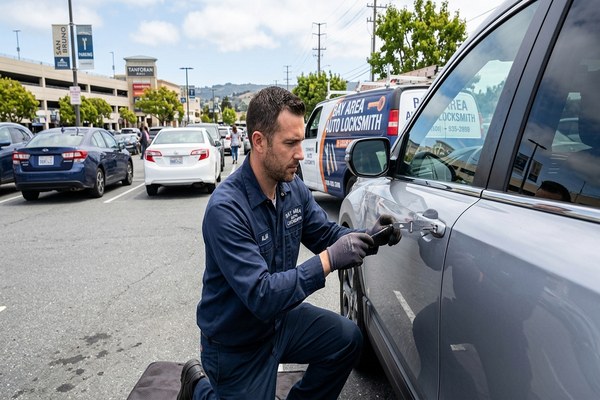
If the car is locked and the key is inside, start with car lockout service. A key broken off in the ignition or door is covered by broken key extraction, and a key that will not turn is covered by ignition switch service. For work on larger vehicles, see truck key replacement.
Most cars built since the late 1990s use a transponder chip the immobilizer must recognize. A cut blade can turn the lock but the engine will not start until the key is programmed to the vehicle.
Adding a spare while a working key exists is usually simpler than an all-keys-lost job, which can need more time and more vehicle-specific work. Ask for the scope in writing before work begins.
The vehicle make, model and year, the key type, whether any working key exists, the VIN, and registration or title with a matching photo ID.
No one can honestly promise that. Some models need dealer-level procedures, and support varies by vehicle and key system. Call (650) 489-0999 with the vehicle details and ask whether yours is supported.
Call for help: (650) 489-0999